







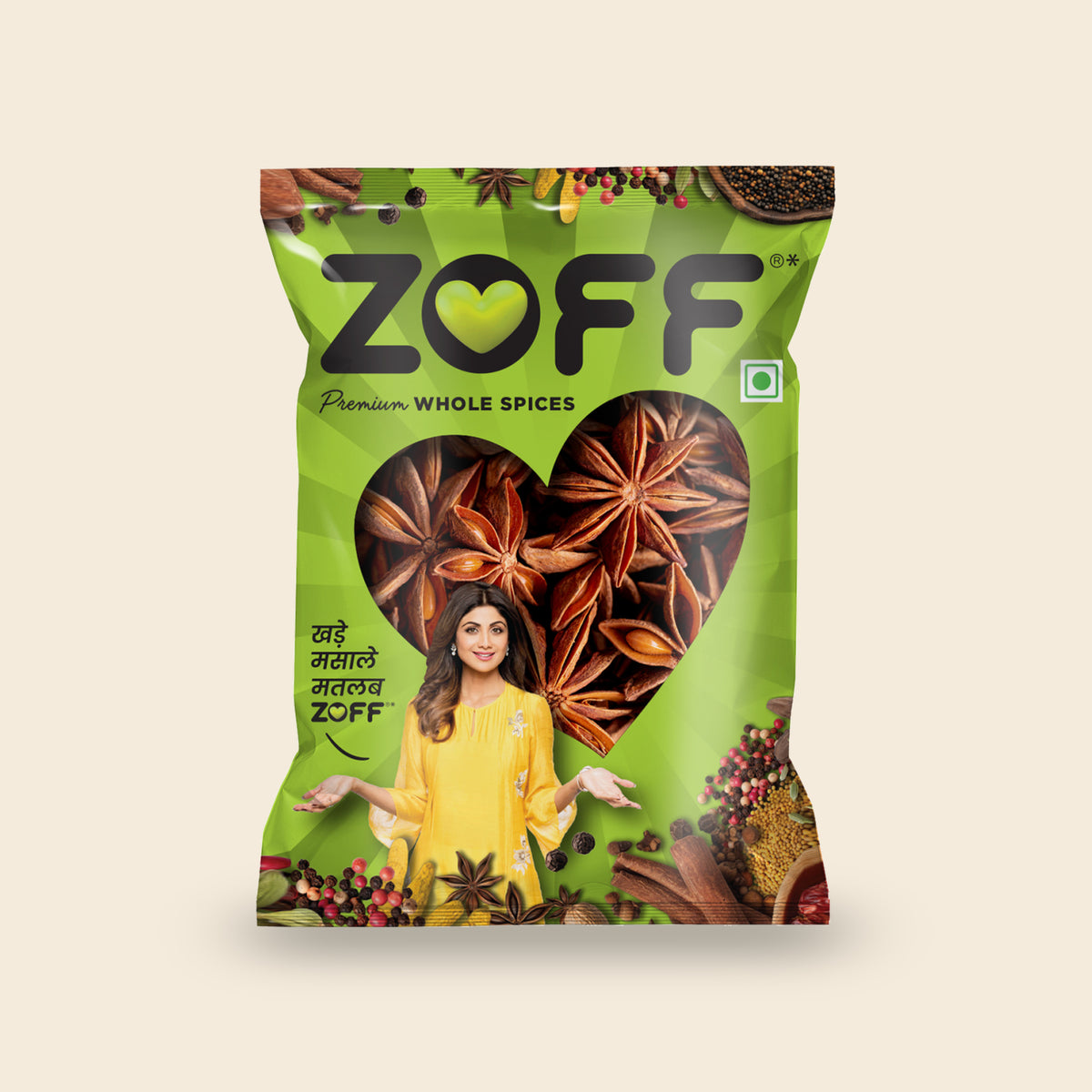


Star anise that shows up whole.
Broken stars: 2.41%, against the 25% the rules allow. Stalks: none. And 8.94% aroma oil, so one star is plenty.
Pack size
Quantity
Check delivery to your area
- 100% secure payments
- COD available
- Next day delivery
Description
Star anise is the spice you can judge by eye. A good one is a full star, deep brown, and smells of liquorice the moment the pack opens. A bad one is a bag of broken points and stalks.
Ours came back with broken or misshapen stars at 2.41%; FSSAI allows up to 25. Stalks: none. Extraneous matter: none. Aroma oil: 8.94 g per 100 g, above the 8.0 minimum, which is why one star can perfume a whole pot of biryani.
Lead, arsenic, aflatoxins and about 290 pesticides were below what the lab can measure.
How to use
Ingredients & storage
Lab reports
- Aroma oil (volatile oil)
- 8.94 g/100 gMin 8.0
- Broken or abnormal stars
- 2.41 g/100 gMax 25.0
- Stalks
- NilMax 3.0 g/100 g
- Extraneous matter
- NilMax 1.0 g/100 g
- Grit (acid-insoluble ash)
- 0.38 g/100 gMax 1.0
- Lead, arsenic, copper
- Below measurable limitLead max 10 mg/kg
- Aflatoxins, pesticides (about 290)
- Below measurable limit
Spices with nothing to hide
You deserve to know what goes into your food. See what we tested and read the results for yourself.
Questions about our lab results
- What does lab tested mean?
- The report names the product sample, the checks carried out and the result of each check. Different products need different tests, so the full report tells you exactly what was covered.
- What does below quantification limit mean?
- It means the amount was below the level the test could reliably measure as a number. It does not mean zero. The report gives the test’s limit.
- What does volatile oil tell me?
- Volatile oils contribute to a spice’s aroma. This test measures the oil content; it is one quality measure alongside the other checks in the report.
- Why is moisture checked?
- Moisture is the water present in the sample. Measuring it helps assess the product’s condition and suitability for storage. It is not a shelf-life guarantee.
- Are curcumin and curcuminoids the same?
- Curcuminoids are a group of compounds that includes curcumin and contributes to turmeric’s colour. A curcuminoid result should not be presented as a separate curcumin result.

We tested it.
Here's the receipt.
Newcon Consultants & Laboratories, Ghaziabad (NABL TC-17937) · report TP-26-NCL/011-300726/A · issued 07 Aug 2026 · batch ZGSA230001
ZOFF Star anise that shows up whole.
Good together in your kitchen
Purity you
can check.
Our purity and quality checks are backed by lab reports. Open the Lab reports tab on any product that has one to see what was tested and what came back.
- Hand-sorted
- Backed by lab reports
- Cool-ground powders
- Resealable zip-lock
How long will it last?
One pack lasts days
Use this as a guide. The amount you need depends on your recipe and taste.
What customers are saying
Star anise, saunf and aniseed: what's the difference?
Three different plants that share a liquorice note. Star anise (chakri phool) is the star-shaped fruit of Illicium verum. Saunf is fennel seed. Aniseed (vilayati saunf) is a smaller seed from Pimpinella anisum.
How many star anise go in a biryani?
One for a family-size pot. It's strong; two can make the whole dish taste of liquorice.
Can you eat star anise?
You cook with it and take it out before serving. The star itself is tough and woody.
How do I store star anise?
Sealed, away from heat and light. Best before about 12 months from manufacture.


