Two jars sit next to each other in the salt section of most Indian grocery stores. One says Kala Namak. The other says Sendha Namak or Himalayan Pink Salt. Both cost more than regular iodised salt, and both come with health claims printed in small text on the back.
If you cook Indian food at home, you have probably used kala namak without thinking much about it. A pinch on sliced raw mango, a shake into chaat masala, a spoonful stirred into nimbu pani on a hot afternoon. Pink salt showed up in most Indian kitchens more recently, marketed over the past decade as a "healthier" alternative to table salt. But are they interchangeable? And if you had to pick one, which one makes more sense for how you actually cook?
What is black salt (Kala Namak)?
Kala namak is not something you mine and put straight in a jar. The traditional process starts with raw rock salt mixed with charcoal, harad (Terminalia chebula), amla (Indian gooseberry), bahera (Terminalia bellirica), and other herbal ingredients. This mixture goes into a ceramic vessel and gets fired in a kiln at high temperatures, sometimes for over 24 hours.
During that firing, chemical reactions produce sulphur compounds, primarily hydrogen sulphide and iron sulphides, that embed themselves in the salt crystals. These compounds give kala namak its egg-like smell and pungent, savoury taste. The colour, despite the name, is usually pinkish-purple or dark reddish-brown when ground. The "black" refers to the raw chunks before grinding.
In Ayurveda, kala namak is classified as having "ushna virya" (heating potency) and is traditionally valued as a digestive salt. You will find it in formulations like Hingvastak Churna, recommended for bloating and gas relief. In the kitchen, it goes on practically everything that counts as chaat.
Worth knowing: not all commercially available black salt is made through traditional kiln-firing. Some manufacturers produce synthetic versions through chemical neutralisation and then add colouring to mimic the look. Others mix ordinary Mediterranean salt with activated charcoal. If you want the real thing, check that the product specifies traditional processing with herbal ingredients and carries proper FSSAI labelling. For more on spotting adulteration in spices, ZOFF has a practical guide.
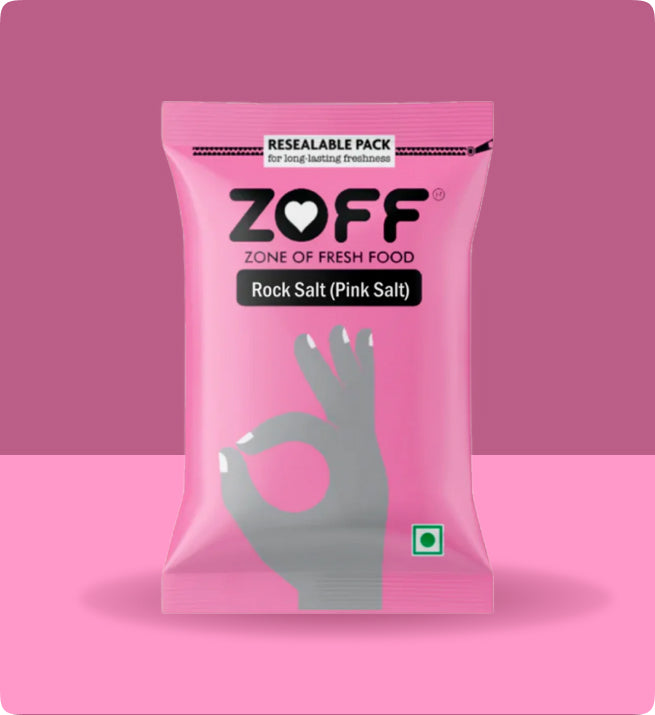
What is pink salt (Sendha Namak)?
Pink salt, also called Sendha Namak or Himalayan rock salt, comes from ancient salt deposits in the Himalayan foothills, primarily in Pakistan's Punjab region. These deposits formed millions of years ago from evaporated seawater that was sealed under rock layers through tectonic shifts. The pink colour comes from trace iron oxide in the crystals.
Unlike kala namak, pink salt goes through minimal processing: mined, washed, ground. The taste is mild, slightly sweet, and clean, without any strong aroma. Pink salt is the only salt traditionally permitted during Hindu fasting days (vrat), which is why many households keep a jar around even if they primarily cook with iodised table salt. In Ayurveda, Sendha Namak is considered cooling in nature and is recommended for balancing Pitta and Vata doshas.
How they taste (and where each one belongs)
This is where the two salts stop being comparable and become completely different tools in the kitchen.
Kala namak has a sulphurous, egg-like flavour that hits you the moment you open the jar. That smell puts some people off, but in the right dish, nothing else comes close.
- Sprinkle it on cut fruit with a squeeze of lime and watch the plate disappear in minutes.
- Stir it into jaljeera or aam panna. Add it to raita, or dust it over papdi chaat and bhel puri.
That tangy, savoury punch is the reason chaat masala blends would fall completely flat without it. Black salt is the soul of Indian street food seasoning, and once you start noticing its absence, you cannot un-notice it.
Vegan cooks have another reason to keep kala namak around. That egg-like flavour makes it the closest substitute for eggs in dishes like tofu scramble, vegan omelettes, and plant-based egg salads. A small pinch goes a long way, and the resemblance is surprisingly convincing.
Pink salt, on the other hand, works as a direct replacement for regular table salt in nearly any recipe. Dal, sabzi, curries, soups, marinades, baking, pickling. The flavour is neutral enough that your dish will taste the same as it would with regular salt, minus the anti-caking agents and heavy processing that come with iodised table salt.
A simple way to think about it:
- Pink salt is your everyday cooking salt.
- Black salt is your finishing salt, the one you reach for when a dish needs that specific kala namak character.
What about minerals?
Both salts contain trace minerals that regular table salt does not, and this is a large part of how they are marketed. Black salt tends to be higher in iron and potassium. Pink salt is typically richer in calcium and magnesium. Both have lower sodium than standard iodised table salt, with kala namak generally being the lower-sodium option of the two.
Here is the part that most comparison articles gloss over: the amounts per serving are small. A pinch of salt on your chaat is not going to meaningfully change your daily iron or magnesium intake. The practical advantage of both salts over heavily processed table salt is that they are less refined and free from artificial additives. Think of the mineral content as a bonus rather than a reason to eat more salt.
The one genuine nutritional edge worth noting with kala namak is its lower sodium content. If you are watching your sodium intake, using kala namak as a seasoning where the flavour works can help reduce how much sodium goes into a dish without sacrificing taste.
Which one should you pick?
Kala namak makes sense if you cook Indian street food at home, want that chaat flavour on fruits and salads, cook vegan dishes that need an egg-like taste, or want a lower-sodium seasoning option. In Ayurveda, it is traditionally valued as a digestive aid for bloating and acidity, though you should consult a healthcare provider before relying on any food as a remedy.
Pink salt makes sense if you need a mild, everyday alternative to iodised table salt, observe religious fasting where Sendha Namak is required, or simply want a less processed salt for general cooking.
Most Indian households that take their chaat seriously keep both. They do different jobs, and trying to substitute one for the other usually ends in a dish that tastes wrong. If you are buying one for the first time, start with whichever matches how you actually cook. For chaat, fruit, and vegan cooking, that is kala namak. For everyday dal and sabzi, that is pink salt.
Where to find good kala namak
The synthetic black salt problem mentioned earlier is real, so sourcing matters. Look for FSSAI-compliant labelling, traditional kiln-fired processing, and a product that actually lists its ingredients rather than just saying "black salt" on the front. ZOFF (Zone of Fresh Foods) makes a Kala Namak that is ground using cool grinding technology below 60°C and packed in resealable zip-lock packaging. You can find it alongside their full range of powdered spices and seasonings on our website.


 Sold out
 Sold out
 Sold out