Think about how many times a week you open that packet of haldi. Haldi is used in dal for lunch, sabji for dinner, and a glass of haldi milk before bed. Your family eats turmeric almost every single day, trusting that bright yellow powder to be exactly what the label says. But what if it is not?
Between November 2024 and February 2025, FSSAI collected over 10,000 spice samples across India and flagged illegal colours in turmeric, excess lead in chilli powder, and misleading labels (source). With roughly 80% of India's whole spices market still unorganised, the chances of picking up adulterated haldi from an unverified source are higher than most people realise. So, is my turmeric pure?
The good news is that you do not need a lab. Four simple tests, using things already in your kitchen, can flag common adulterants in about two minutes. Here is how to check turmeric adulteration at home.
The 4 tests at a glance
-
Water settle test. Drop turmeric in water and wait 15 minutes. If the water turns bright yellow instantly, your turmeric may contain artificial dyes.
-
Lemon test. Squeeze lemon on a pinch of turmeric on a white plate. If it turns a lasting pink, your haldi may contain metanil yellow dye.
-
Palm rub test. Rub turmeric on your palm for 15 seconds. If the powder falls off easily and barely stains, fillers may be present.
-
Iodine test. Add iodine drops to turmeric on a plate. If it turns blue-black, starch or flour has likely been mixed in.
What Gets Added to Turmeric (and Why)
The short answer is money. Whole turmeric roots are hard to tamper with because you can see and feel them. Once ground into powder, though, the identity disappears into a uniform colour and texture, and mixing in cheaper substances becomes easy. Curcumin, the compound that gives haldi its natural golden-yellow colour, is what makes turmeric valuable. Haldi adulteration targets exactly this quality, making low-curcumin or diluted turmeric look like the real thing.
Common Adulterants in Haldi
The substances most frequently found in adulterated turmeric powder include:
-
Metanil yellow, a synthetic industrial dye that FSSAI classifies as a non-permitted food colour. Added to make dull turmeric look brighter.
-
Lead chromate, a toxic pigment used in industrial paints. A Stanford University study analysing 356 turmeric samples across South Asia found lead levels in some Indian samples far exceeding safe limits.
-
Chalk powder (calcium carbonate), added to increase weight and bulk.
-
Starch or flour (wheat/rice), used as filler to stretch a small quantity of real turmeric into a larger one.
FSSAI's DART (Detect Adulteration with Rapid Test) manual, a free government resource, lists several of these adulterants and provides household-level tests to detect them (source).
4 Home Tests to Check if Your Turmeric Is Pure
All you need is a glass of water, a lemon, a white plate, and iodine solution from a first-aid kit. Keep in mind that these are screening tests, not lab-grade analysis. No home test catches every adulterant with certainty, and some, like lead chromate, need proper laboratory equipment. That said, these four checks can catch the most common forms of haldi adulteration and are well worth two minutes of your time.
Test 1: The Water Settle Test (Detects Artificial Dyes and Fillers)
Add half a teaspoon of turmeric powder to a glass of room-temperature water. Do not stir. Wait about 15 minutes.
Pure turmeric settles slowly at the bottom, and the water turns a light, pale yellow.
Adulterated turmeric turns the water deep, bright yellow almost immediately, often with colour streaks before the powder settles. Heavy white sediment at the bottom may point to chalk. To double-check for chalk, add a few drops of lemon juice. Fizzing or bubbling suggests calcium carbonate, because chalk reacts with acid to release gas.
Worth noting: some sources claim this test also detects lead chromate. Stanford researcher Dr Jenna Forsyth has noted that curcumin interferes with home test results, making them ineffective for lead detection (source). For lead, professional lab testing is the only dependable method.
Test 2: The Lemon or Acid Test (Detects Metanil Yellow)
Place a small pinch of haldi on a white plate and squeeze 3 to 4 drops of lemon juice onto it.
Pure turmeric stays yellow or turns slightly deeper yellow, with no dramatic shift.
Adulterated turmeric turns a persistent, bright pink or magenta that stays even after a few seconds, signalling the likely presence of metanil yellow. FSSAI's DART manual specifically lists this as a household test for metanil yellow in turmeric.
One small detail: pure curcumin can also react with acid and briefly turn slightly pink before reverting to yellow. Metanil yellow, on the other hand, produces an intense pink that does not fade. A lasting bright pink is the warning sign.
Test 3: The Palm Rub Test (Detects Fillers and Artificial Colour)
Take a pinch of turmeric and rub it vigorously on your palm for 15 to 20 seconds, then turn your hand upside down.
Pure turmeric sticks to the skin and leaves a deep yellow-orange stain that is hard to wash off.
Adulterated turmeric falls off the palm easily, leaving a pale, powdery residue. If the stain washes off with plain water in seconds, fillers like chalk or starch may be present.
Test 4: The Iodine Test (Detects Starch or Flour)
Place a teaspoon of turmeric on a white plate and add 2 to 3 drops of iodine solution (the brown antiseptic liquid from your first-aid box).
Pure turmeric shows no dramatic colour change. The iodine stays brown or turns slightly darker.
Adulterated turmeric turns blue-black. A blue-black reaction strongly indicates added starch, meaning wheat flour, rice flour, or another filler has likely been mixed in.
Why Adulterated Turmeric Is a Health Concern
Most families use turmeric every day, and daily consumption of adulterated haldi over months and years adds up. Metanil yellow may cause liver and kidney damage with prolonged exposure. Lead chromate accumulates in the body and may affect the nervous system, kidneys, and cognitive development, particularly in children. Even "harmless" fillers like starch and chalk reduce the curcumin you are actually getting, so your turmeric ends up doing less for your food and your body than you expect.
A pure haldi test at home takes two minutes. The health cost of skipping it builds up over years.
How to Identify Pure Turmeric Powder Before You Buy
Running a turmeric powder purity test at home is useful, but catching the problem before it enters your kitchen is even better.
-
Check the label. A valid FSSAI licence number, batch number, manufacturing date, and expiry date should all be clearly visible.
-
Look at the colour and smell. Natural turmeric powder is a warm, earthy yellow with a distinct aroma. Unnaturally bright powder or a flat smell are red flags.
-
Buy sealed, branded packs. Loose powder from open bins has no traceability. Branded powdered spices with FSSAI credentials offer far more accountability.
-
Consider whole spices and grind at home. Whole turmeric roots are much harder to adulterate than powder.
How ZOFF Helps You Skip the Guesswork
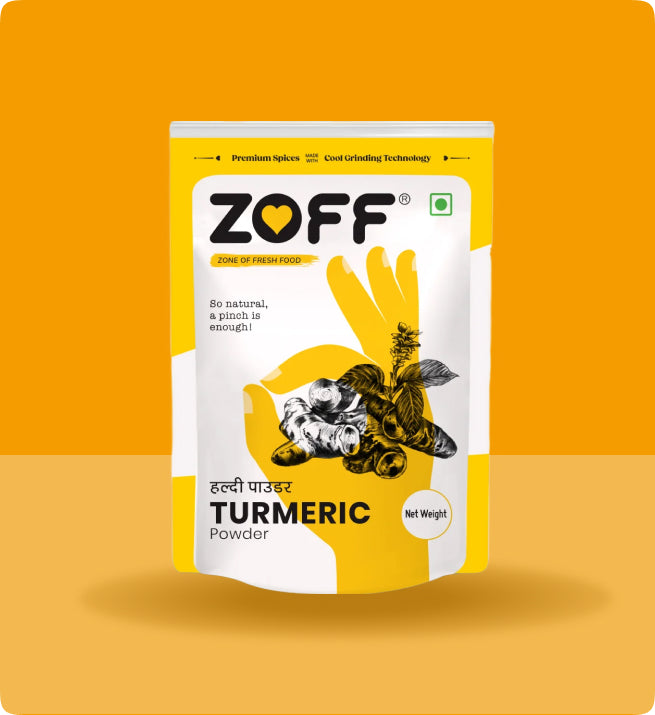
Every test above exists because a large share of India's spice market, especially whole spices, remains unorganised. ZOFF's turmeric powder is grounded using cool grinding technology below 60°C, preserving natural flavour, aroma, colour, and nutrients. Every pack comes in resealable zip-lock packaging, and every batch is traceable back to source through ZOFF's FSSAI-licensed facility. Browse the full range at zofffoods.
Explore Other Blogs
Turmeric History|Turmeric Benefits|Inflammation Spices|Haldi Milk Benefits|Spices History
Disclaimer: The information in this blog is for general informational purposes gathered from various sources. Zoff Foods does not guarantee specific health or nutritional outcomes. Please consult a qualified health professional for personalised dietary advice.


 Sold out

 Sold out