






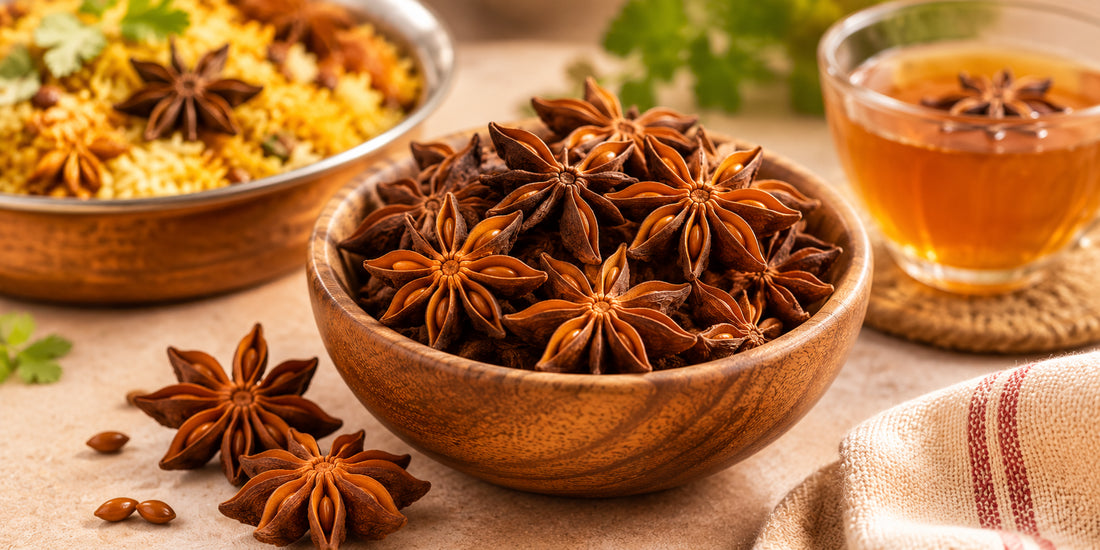
Open a pot of biryani and you'll catch a warm, sweet, licorice-like note under the saffron and ghee. That's star anise. In most Indian kitchens it's called chakra phool, the "wheel flower", and it's one of the few whole spices you can recognise at a glance.
Star anise (Illicium verum), commonly called chakra phool, is a star-shaped aromatic spice used in Indian cooking, especially biryani, pulao and spice blends. It contains naturally occurring compounds such as anethole and shikimic acid. Although traditionally associated with digestive comfort, many proposed health benefits still lack sufficient clinical evidence in humans.
It's the dried fruit of an evergreen tree native to southern China and Vietnam, usually with eight points, each holding a glossy seed.
9 Star Anise Benefits and Uses
These combine culinary strengths with researched properties. Where evidence comes only from lab studies, we say so.
1. A natural flavour builder: Dried star anise holds about 8–9% essential oil, and trans-anethole makes up roughly 80–90% of that oil. That's why one pod can flavour a whole pot.
2. The aromatic base of biryani and pulao: Tempered in ghee with bay leaf and cinnamon, it gives Hyderabadi biryani and Kashmiri pulao their layered, slightly sweet depth.
3. Ties garam masala together: A small amount bridges the heat of pepper and cloves with the sweetness of cinnamon, the same whole-spice balance behind garam masala.
4. Traditionally used for digestive comfort: Indian and Chinese traditions use it as a carminative after heavy meals. Human clinical trials are limited, so treat this as traditional use, not a treatment.
5. Rich in plant compounds: A 2023 review identified 201 chemical constituents in star anise, including linalool, quercetin and gallic acid. Several show antioxidant activity in lab tests.
6. Antimicrobial activity in the lab: Its essential oil has inhibited certain bacteria and aflatoxin-producing moulds in laboratory studies. This hasn't been shown in people eating the spice.
7. A source of shikimic acid: Shikimic acid from star anise has been used as a starting material for the flu drug oseltamivir (Tamiflu). That's a pharmaceutical process; eating star anise does not treat or prevent flu.
8. Sweetness without sugar: Anethole tastes naturally sweet, so a pod in chai or kheer rounds out flavour and can let you use less sugar.
9. Flavour with almost no calories: One or two pods add aroma without salt, fat or meaningful calories, and whole pods keep their aroma far longer than ground spice.
Star Anise Nutritional Value
Star anise is used in such small amounts that its nutrient contribution per serving is negligible. Its value lies in its bioactive compounds:
|
Compound |
Why it matters |
|---|---|
|
Trans-anethole |
Main aroma molecule; sweet, licorice-like note |
|
Shikimic acid |
Pharmaceutical precursor; studied in labs |
|
Linalool, limonene |
Floral and citrus top notes |
|
Quercetin, gallic acid |
Polyphenols with antioxidant activity in lab tests |
How to Use Star Anise in Indian Cooking
Follow the Bloom–Simmer–Remove framework:
- Bloom: Fry 1-2 pods in hot ghee for 20–30 seconds, until fragrant, before adding onions or rice.
- Simmer: Let it cook with the dish so its oils release slowly into gravies, stocks and dum biryani.
- Remove: Take the pod out before serving; its woody points are unpleasant to bite.
|
Dish |
Form |
Quantity (serves 4) |
|---|---|---|
|
Biryani, pulao |
Whole |
1–2 pods |
|
Garam masala |
Dry-roasted, ground |
1 pod per 2 tbsp blend |
|
Masala chai |
Whole, simmered |
1 pod per 4 cups |
|
Nihari, meat curries |
Whole |
1 pod |
For consistent aroma, start with whole star anise and grind only what you need. Stock the rest of your khade masale from ZOFF Whole Spices.
Safety: Choose Food-Grade Chinese Star Anise
The US FDA considers Chinese star anise (Illicium verum) generally recognised as safe as a spice. It must not be confused with Japanese star anise (Illicium anisatum), which is toxic and looks almost identical.
In 2003 the FDA warned against star anise teas after at least 40 people, including 15 infants, fell ill; some teas were contaminated with the Japanese species. Buy from a trusted brand, use cooking quantities, and never give star anise tea to infants.
Explore Other Blogs
Hing Benefits|Indian Spices for Digestion|Turmeric Powder Benefits|Jeera Benefits|Spices Benefits
Disclaimer: The information in this blog is for general informational purposes gathered from various sources. Zoff Foods does not guarantee specific health or nutritional outcomes. Please consult a qualified health professional for personalised dietary advice.
Frequently asked
What are the main health benefits of star anise?
It contains anethole, shikimic acid and antioxidant polyphenols, is traditionally used for digestive comfort, and shows antioxidant and antimicrobial activity in lab studies. Human evidence is limited.
Is star anise good for digestion?
It has long traditional use as a carminative for gas and bloating after rich meals, but human clinical trials are limited.
Can star anise be consumed every day?
Yes, in normal cooking amounts for most healthy adults. Avoid concentrated teas or extracts; pregnant or breastfeeding women and people on medication should ask a doctor first.
What is star anise called in Hindi?
Chakra phool. It's also called badiyan in Urdu and parts of North India.
What are the uses of star anise in biryani and Indian curries?
It's fried whole in ghee to build a sweet, warm base for biryani, pulao, nihari and korma, ground into garam masala, and removed before serving.
What is the difference between star anise and anise seeds?
Star anise (Illicium verum) is a star-shaped tree fruit; anise seed (Pimpinella anisum) is a small herb seed. Both owe their flavour to anethole, but star anise is bolder and woodier.
Are there any side effects of consuming star anise?
Rare in cooking amounts, though allergies occur. Large doses, or products contaminated with toxic Japanese star anise, have caused vomiting and seizures, mainly in infants given star anise tea.