






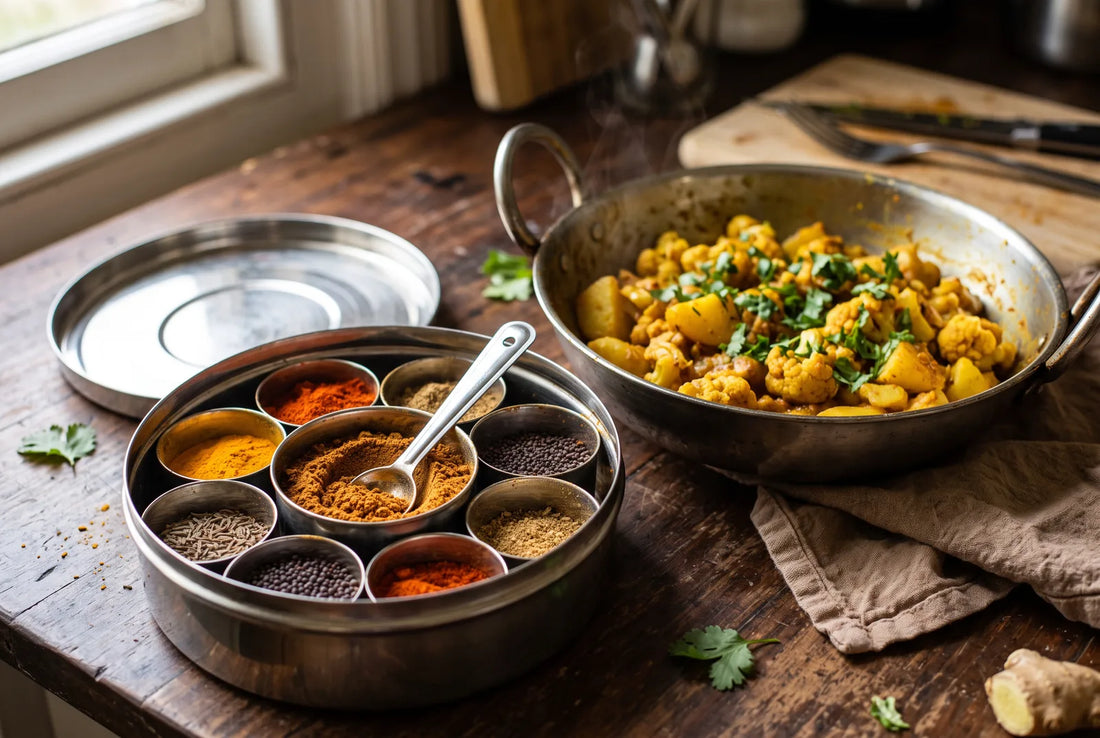
Sabji masala is the spice blend that does the most work in an Indian kitchen and gets the least credit for it. Most home cooks in North India use it almost every day, in almost every vegetable dish, and barely think about it. It goes into the oil after the onions, the vegetables go in after it, and dinner is ready in 20 minutes. There is no drama, no elaborate layering, no tempering rituals. You add a teaspoon, stir, and the sabzi tastes like it is supposed to.
That simplicity is also why nobody writes about it. Garam masala has its loyalists. Biryani masala has an entire subculture. Sabji masala just sits in the masala dabba and gets used until the packet is empty, and then someone buys another one. But the blend itself is worth understanding, because the difference between a good sabji masala and a mediocre one is the difference between a vegetable dish that actually tastes like something and one that tastes like turmeric and chilli with some vegetables in it.
What Is Sabji Masala?
Sabji masala is a blended spice mix designed for everyday vegetable cooking. The name translates directly: sabji (vegetable) masala (spice blend). You will also hear it called sabzi masala, sabji ka masala, or just "vegetable masala" on English-language packaging. In Bengali and Nepali households, a similar blend goes by tarkari masala.
The blend sits somewhere between plain turmeric-chilli-coriander (the bare minimum for a sabzi) and garam masala (which is a finishing spice, not a cooking spice). Sabji masala is meant to go into the oil during cooking and carry flavour through the entire dish. It has enough range that you can skip adding turmeric, coriander powder, and chilli separately, because the blend already contains all of them in roughly the right proportions.
What Goes Into Sabji Masala
The ingredient list is shorter than kitchen king masala but longer than a basic haldi-mirch-dhaniya trio. A typical sabji masala contains:
|
Spice |
What it does in the blend |
|
Coriander |
The base; mild, citrusy, adds body |
|
Cumin |
Earthy, savoury anchor |
|
Turmeric |
Colour and a faint bitter warmth |
|
Red chilli |
Mild heat (less than in a meat masala) |
|
Black pepper |
Background heat, slightly different from chilli |
|
Fennel seeds |
Mild sweetness that rounds out the blend |
|
Cloves and cardamom |
Small amounts for warmth and aroma |
Some blends add fenugreek leaves, amchur, or bay leaf powder, but these six or seven spices are the core. The ratio leans heavily toward coriander, cumin, and turmeric, with the warm spices kept low enough that they do not compete with the vegetables.
The difference between this and garam masala is proportion. Garam masala is built around the warm spices (cardamom, cinnamon, cloves, pepper) and contains little or no turmeric. Sabji masala starts with coriander and cumin and adds just enough of the warming spices to give depth without dominating.
How to Use Sabji Masala
The timing depends on the type of dish, and getting this wrong is the most common reason home cooks find their masala either scorched or tasteless.
In Gravy Sabzis
Add 1 to 1.5 teaspoons after the onion-tomato base has softened and the oil starts to separate from the paste. Stir the masala into the base for 30 to 60 seconds before adding the vegetables. This step lets the fat carry the spice oils into the gravy. Sprinkling dry masala onto a finished dish does almost nothing by comparison.
Works in: aloo matar, mixed vegetable curry, paneer bhurji, baingan bharta, dum aloo, or any gravy where you would otherwise add turmeric, chilli, and coriander individually.
In Dry Sabzis
Add about 3/4 to 1 teaspoon when the vegetables are roughly three-quarters cooked, on medium-low heat. Toss well so the masala coats the vegetables evenly. Adding it too early in a dry sabzi risks scorching, because there is no liquid to buffer the heat.
Works in: aloo gobi, bhindi fry, tori or lauki ki sabzi, gobhi fry, jeera aloo. For bhindi, finish with a pinch of amchur alongside the sabji masala for tang.
In Stuffings and Parathas
Use about 1 teaspoon per cup of filling, mixed directly into the potato, paneer, or cauliflower stuffing. The masala seasons the filling from inside, so when the paratha hits the tawa, the spices are already distributed through the dough.
In Dal
Half a teaspoon stirred into the tadka (the tempered oil that gets poured over cooked lentils) works in masoor or moong dal. Finish with a pinch of garam masala on top for aroma.
A Beginner Tip Worth Knowing
If you are new to cooking with spice blends, mix the sabji masala with one or two tablespoons of water to form a loose paste before adding it to the pan. The paste is less likely to burn in hot oil than dry powder, and it distributes more evenly across the dish.
Sabji Masala vs Garam Masala vs Kitchen King
All three blends overlap enough that people use them interchangeably, and for a basic weeknight dinner the result is fine either way. But they are built for different stages of cooking and different flavour profiles.
|
Sabji masala |
Garam masala |
Kitchen king masala |
|
|
Base spices |
Coriander, cumin, turmeric |
Cardamom, cinnamon, cloves |
Coriander, cumin, turmeric, amchur |
|
Heat level |
Mild |
Moderate |
Mild |
|
When to add |
During cooking, with the base |
At the end, as a finishing spice |
During cooking, with the base |
|
Colour |
Yellow-brown |
Dark brown |
Yellow-brown with slight tang |
|
Best for |
Everyday sabzis, dry veg, stuffed parathas |
Finishing curries, biryanis, meat |
Sabzis, paneer gravies, pulao |
The practical difference: sabji masala and kitchen king masala go in early and cook with the dish. Garam masala goes in at the end. Sabji masala is the simplest of the three; kitchen king has a wider ingredient list including amchur and fenugreek, which give it a slight tanginess that sabji masala does not have.
Many cooks use sabji masala as the base and add a pinch of garam masala at the end. That combination covers both roles without needing a separate kitchen king masala at all.
What to Look For When Buying
The ingredient list should name each spice individually. Blends that list "mixed spices" without specifying which ones are usually heavy on the cheap base (coriander and turmeric) and light on everything else.
Smell it when you open the packet. Good sabji masala should have a warm, rounded aroma with a noticeable cumin note. If it smells only like turmeric and chilli powder, the fennel, pepper, and cardamom were either skimped on or processed at temperatures high enough to drive off their volatile oils.
Check the colour. It should be a warm, muted brown with a slight yellow tint. Bright yellow means too much turmeric relative to the other spices. Very dark powder usually means the spices were ground at high temperatures.
Once opened, store it in an airtight container away from the stove. Always use a dry spoon. Moisture and heat degrade the oils faster than time does. Most blends stay usable for 4 to 6 months after opening, but the flavour peaks in the first two.
Try ZOFF Sabji Masala
ZOFF (Zone of Fresh Foods) grinds its Sabji Masala using cool grinding technology below 60°C, so the cumin, fennel, and cardamom oils stay intact through processing instead of evaporating during the grind. The blend is packed in resealable zip-lock packaging to keep moisture out between uses. Browse the full blended spices collection and the spice guide on the ZOFF website for a closer look at what goes into each blend.
Explore Other Blogs
Burger Recipes|Zingy Parcel|Bhelpuri|Makhana Chaat|Dabeli
Disclaimer:The information in this blog is for general informational purposes gathered from various sources. Zoff Foods does not guarantee specific health or nutritional outcomes. Please consult a qualified health professional for personalised dietary advice.
Frequently asked
Can I Use Sabji Masala Instead of Garam Masala?
In a pinch, yes, but the result will taste different. Sabji masala has turmeric and coriander, which garam masala does not. If you substitute, use about half the amount and expect a milder, more earthy flavour rather than the warm aromatic finish that garam masala provides. Many home cooks use both in the same dish: sabji masala during cooking and garam masala at the end.
How Much Sabji Masala Should I Add?
Start with 1 teaspoon per dish for a family of four. For gravy dishes, go up to 1.5 teaspoons. For light vegetables like tori, lauki, or tinda, half a teaspoon is enough. Reduce or skip any separate turmeric, coriander, or chilli powder you would normally add, since the blend already contains them.
Is Sabji Masala the Same as Kitchen King Masala?
Similar but not identical. Kitchen king masala has a longer ingredient list, including amchur (dried mango powder) and fenugreek, which give it a slight tang that sabji masala lacks. Kitchen king also tends to have more warm spices. Sabji masala is simpler and milder, built for plain, everyday vegetable cooking.
Can I Use Sabji Masala in Non-Veg Dishes?
Sabji masala works in mild preparations like egg curry or a simple chicken stir-fry, but for a full meat curry you are better off with a dedicated meat masala that has more heat and black pepper. Sabji masala is calibrated for vegetables, where the flavours are more delicate.
How Do I Store Sabji Masala After Opening?
Keep it in an airtight container, away from the stove and out of direct sunlight. Use a dry spoon every time. Moisture causes the powder to clump and lose aroma. An opened packet stays good for 4 to 6 months; whole spice blends last longer, but ground masalas start fading after the first few months.
Why Does My Sabji Masala Taste Burnt?
You are adding it to oil that is too hot. Powdered spices scorch within seconds in smoking-hot oil. Wait until the onion-tomato base has softened (the oil should be warm, not smoking) before stirring the masala in. If you are making a dry sabzi with no onion-tomato base, lower the flame before adding the masala and keep stirring for 15 to 20 seconds.