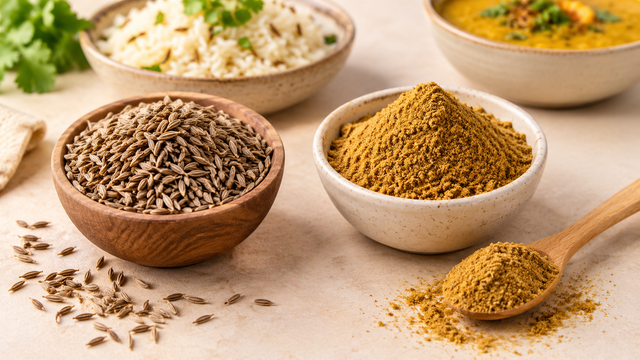








Coriander powder (dhaniya powder) adds a mild, earthy, slightly citrusy flavour to Indian curries and builds a balanced spice base. Cumin powder (jeera powder) adds a warmer, nuttier, more pronounced earthy aroma. The two are often used together, but they are not one-to-one substitutes. How much of each you use depends on the dish.
Open any Indian masala dabba and dhaniya and jeera sit side by side. Both are ground seeds from the same plant family, so they look interchangeable. Cook a dal with one in place of the other, though, and the difference shows within a spoonful.
India grows most of the world's supply of both. It accounted for about 70% of global cumin production and 65% of global coriander production in 2020, according to FAO figures cited in the Indian Journal of Agricultural Economics.
Coriander Powder vs Cumin Powder at a Glance
|
Factor |
Coriander Powder |
Cumin Powder |
|---|---|---|
|
Hindi name |
Dhaniya powder |
Jeera powder |
|
Flavour |
Mild, earthy, citrusy |
Warm, earthy, slightly bitter |
|
Aroma |
Fresh, subtly citrusy |
Nutty, warm, aromatic |
|
Main aroma compound |
Linalool (floral, citrus) |
Cuminaldehyde (warm, savoury) |
|
Common uses |
Curries, gravies, sabzis, marinades |
Curries, dals, raita, spice blends |
|
Cooking role |
Builds the base and thickens |
Adds depth and warmth |
|
Substitution |
Not a direct 1:1 replacement |
Not a direct 1:1 replacement |
What Coriander Powder Does in a Curry
Think of coriander powder as the body of the masala. It is gentle, so cooks use more of it, and it helps thicken gravies while rounding off chilli, tomato and salt. If a curry tastes thin or harsh, a spoon of coriander powder simmered for two minutes usually fixes it.
Coriander powder uses in cooking: onion-tomato gravies, dry sabzis, tikka marinades, sambhar powder and most blended masalas.
What Cumin Powder Does in a Curry
Cumin is the accent. It brings a warm, slightly smoky depth you notice even in small amounts. Too much turns a dish bitter, so recipes use less of it than coriander.
Cumin powder uses in cooking: dals, rajma and chole, jeera aloo, raita and chaas, chaat, and garam masala blends. Dry-roasted cumin powder (bhuna jeera) is sprinkled at the end for a smoky finish.
Dish-by-Dish: Which Powder Leads?
|
Dish |
Coriander powder role |
Cumin powder role |
Typical ratio (C:J) |
Swap one for the other? |
|---|---|---|---|---|
|
Paneer curry |
Main base, thickens gravy |
Light warmth |
2:1 |
Coriander-only works; cumin-only tastes heavy |
|
Dal tadka |
Optional pinch |
Leads, often with whole jeera |
1:2 |
No. Dal loses its warm, smoky note |
|
Chole |
Equal partner |
Equal partner, plus roasted jeera |
1:1 |
No. Both are needed for depth |
|
Mixed vegetable sabzi |
Leads, balances vegetables |
Supporting |
2:1 |
Partly. Use less cumin if swapping in |
|
Raita |
Rarely used |
Roasted powder only |
0:1 |
No. Coriander tastes flat here |
Can You Use Coriander Powder Instead of Cumin Powder?
You can in a pinch, but expect a milder dish without cumin's warmth. In a mixed vegetable sabzi or paneer curry, where coriander already leads, the swap is barely noticed. In dal tadka or chole, where cumin carries the flavour, the dish tastes flat.
Can I substitute cumin for coriander? Use about half the amount, because cumin is stronger and a full measure can overpower a paneer gravy.
A simple swap framework:
- Check which spice leads the dish (see the table above).
- If the missing spice only supports, skip it or replace it at half quantity.
- If the missing spice leads, add a pinch of garam masala, which already contains both, and taste before adding more.
The Coriander and Cumin Powder Ratio
A 2:1 coriander-to-cumin ratio suits most North Indian onion-tomato gravies. For a 4-serving curry, that is about 2 tsp coriander powder and 1 tsp cumin powder. Move to 1:1 for chole, rajma and meat curries, and let cumin lead in dals and jeera aloo.
When to Add Each While Cooking
Add both after the onions and tomatoes have cooked down and the oil starts to separate. Cook them for 30 to 60 seconds on low heat. Coriander turns bitter once scorched, so add a splash of water if the pan looks dry. Keep roasted cumin powder for the very end or for garnishing.
Powders lose aroma over time, so freshness matters. ZOFF Coriander Powder is cool-ground from whole seeds to keep its natural oils, with no preservatives or added colour. Pair it with ZOFF Jeera Powder for a balanced base. For more on dhaniya, read our coriander powder guide.
Explore Other Blogs
Coriander Powder|Spices Benefits|Hing Benefits|Jeera Benefits|Spices for Digestion
Disclaimer: The information in this blog is for general informational purposes gathered from various sources. Zoff Foods does not guarantee specific health or nutritional outcomes. Please consult a qualified health professional for personalised dietary advice.
Frequently asked
What is the difference between coriander powder and cumin powder?
Coriander powder is mild, earthy and citrusy, and builds a curry's base. Cumin powder is warmer, nuttier and slightly bitter, and adds depth, so it is used in smaller amounts.
What does coriander powder do in Indian curry?
It gives body, thickens the gravy and balances chilli, tomato and salt.
What flavour does cumin powder add to a curry?
A warm, nutty, slightly smoky earthiness. Roasted cumin powder adds a stronger smoky note.
Can you substitute coriander powder for cumin powder?
Only partly. It works in dishes where cumin plays a supporting role, such as paneer curry. In dal or chole, add a pinch of garam masala instead.
Why are coriander and cumin powder used together in Indian cooking?
Coriander supplies a mild, citrusy base and cumin adds warmth, so together they give balance and depth.
What is the ideal coriander-to-cumin ratio for Indian curries?
2:1 for most onion-tomato gravies, 1:1 for chole, rajma and meat curries, and cumin-led for dals and jeera aloo.
When should coriander and cumin powder be added while cooking?
After the onion-tomato masala releases oil, for 30 to 60 seconds on low heat. Add roasted cumin at the end.