






Kitchen King masala sits in a strange spot. Nearly every Indian grocery store stocks it, and it is probably the most commonly used blended spice in North Indian home kitchens after garam masala, but nobody really talks about it. There are no debates about the perfect ratio, no strong opinions about which version is definitive. People just open the packet, add a teaspoon to whatever sabzi they are making, and move on. That is partly because Kitchen King Masala is designed to be invisible. It makes ordinary vegetables taste like they were cooked by someone who knows what they are doing, without any single spice announcing itself.
What Is Kitchen King Masala?
Kitchen King masala is a blended spice mix used primarily in vegetable dishes, North Indian gravies, and rice. It is a wider-spectrum version of garam masala, with extra spices added for colour, body, and a mild tanginess that garam masala lacks. The name translates roughly to "king of the kitchen," which sounds grandiose for a blend that is meant for everyday cooking rather than special occasions.
Most Indian households that use Kitchen King Masala reach for it more often than they reach for garam masala, because it works in a broader range of dishes without needing other spices alongside it.
What Goes Into Kitchen King Masala
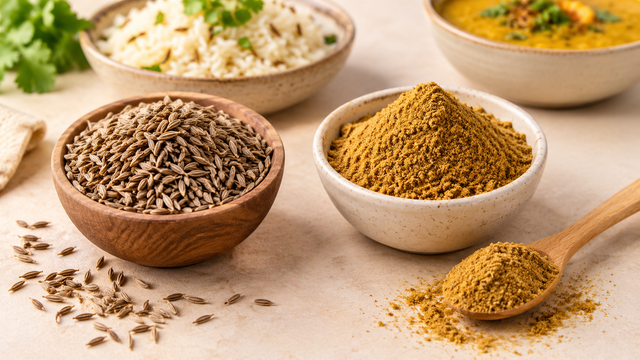
The ingredient list is longer than most Indian spice blends, which is the point. A typical kitchen king masala contains:
|
Spice |
What it does |
|
The base; adds body and a mild citrus note |
|
|
Earthy, savoury anchor |
|
|
Colour and a faint bitterness |
|
|
Mild heat (less than in a meat masala) |
|
|
Sweetness and aroma |
|
|
Cinnamon (cassia) |
Warmth |
|
Sharp, pungent note |
|
|
Background heat |
|
|
A mild anise sweetness |
|
|
Amchur (dried mango) |
Tanginess that sets it apart from garam masala |
|
Fenugreek (dried leaves or seeds) |
Slight bitterness, common in Punjabi cooking |
|
Nutmeg and mace |
Warmth in small amounts |
|
Background aroma |
The amchur and fenugreek are what make kitchen king masala taste different from garam masala. Without them, you have a spice blend that does roughly the same job. With them, you get a slight sourness and a green, leafy undertone that works particularly well in potato and cauliflower dishes.
How to Use Kitchen King Masala
In Sabzis
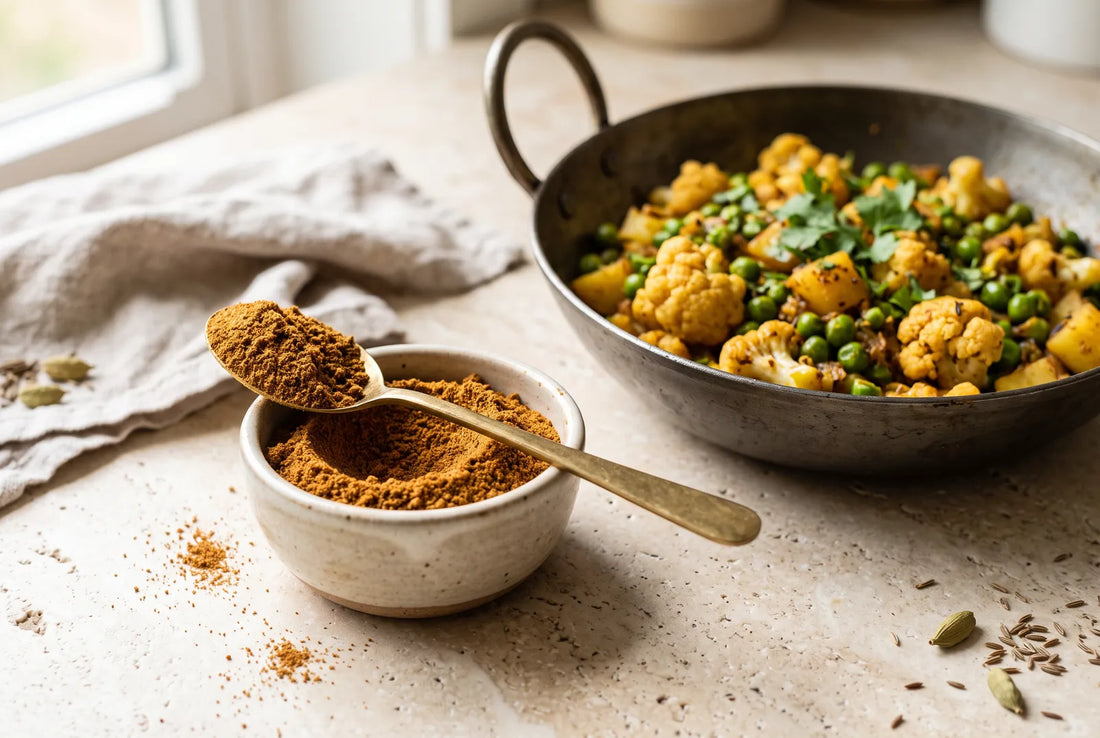
This is where Kitchen King Masala does its best work. Add 1 to 1.5 teaspoons to the oil after the onions and tomatoes have cooked down, before the vegetables go in. It works in nearly any sabzi: aloo gobi, mixed vegetable, bhindi, paneer, baingan. The blend has enough range that you do not need to add garam masala, turmeric, or chilli separately. One spoonful handles all of it.
For a dry sabzi (like aloo jeera or bhindi fry), use about 1 teaspoon per 500g of vegetables. For a gravy-based dish, use 1.5 teaspoons, since the liquid dilutes the flavour.
In Curries and Gravies
Kitchen King masala works in paneer butter masala, navratan korma, and most North Indian gravies. It is milder than a dedicated sabji masala or a meat masala, which makes it a better choice for rich, creamy gravies where you want the spices to sit in the background rather than dominate. Add it when you add the tomato paste or puree, so it cooks into the base.
In Pulao and Rice Dishes
A teaspoon of Kitchen King masala stirred into the rice and water before cooking gives a vegetable pulao a warm, lightly spiced flavour without needing to temper whole spices separately. It does not have the depth to work as the sole spice in a biryani, but for a quick weeknight pulao it saves about ten minutes of prep.
Kitchen King Masala vs Garam Masala
These two get used interchangeably, and for a weeknight dinner the difference is not always obvious. But they are built for different jobs.
|
Kitchen king masala |
Garam masala |
|
|
Colour |
Lighter, slightly yellow from turmeric |
Dark brown |
|
Heat level |
Mild |
Moderate |
|
Tanginess |
Yes (from amchur) |
No |
|
When to add |
During cooking, with the base |
At the end, as a finishing spice |
|
Best for |
Sabzis, paneer, pulao |
Finishing curries, biryanis, meat dishes |
The practical difference: kitchen king masala goes in early and cooks with the dish. Garam masala goes in at the end to add aroma. Using kitchen king masala as a finishing spice wastes its range, and using garam masala as a cooking spice burns off its volatiles before you eat.
What to Look For in a Kitchen King Masala
The spice list should name each ingredient individually. Kitchen King masala contains 12 to 15 spices, and blends that list "mixed spices" as a single line are usually heavy on the cheap fillers (coriander, turmeric, chilli) and light on the expensive ones (cardamom, mace, nutmeg).
Smell it when you open the packet. A good kitchen king masala should smell warm and slightly sweet, with a faint tang from the amchur. If it smells mostly like turmeric and chilli powder, the aromatic spices were either skimped on or lost their oils during processing.
Check the colour. It should be a warm, muted brown with a slight yellow tint. Bright yellow usually means excess turmeric. Dark brown usually means the spices were ground at high temperatures.
Try ZOFF Kitchen King Masala
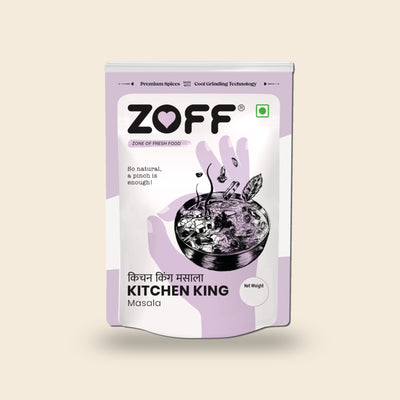
ZOFF (Zone of Fresh Foods) grinds its Kitchen King Masala using cool grinding technology below 60°C, so the cardamom, mace, and fenugreek oils stay intact through processing. The blend is packed in resealable zip-lock packaging to keep moisture out. Browse the full blended spices collection and the complete spice range on the ZOFF website and pick it up next time you are restocking the masala shelf.
Explore Other Blogs
Burger Recipes|Zingy Parcel|Bhelpuri|Makhana Chaat|Dabeli
Disclaimer:The information in this blog is for general informational purposes gathered from various sources. Zoff Foods does not guarantee specific health or nutritional outcomes. Please consult a qualified health professional for personalised dietary advice.
Frequently asked
What Is the Difference Between Kitchen King Masala and Sabji Masala?
Sabji masala is a simpler blend designed specifically for dry and semi-dry vegetable dishes. Kitchen King Masala has a wider ingredient list, including amchur and fenugreek, which give it more range. Kitchen King works in gravies, rice, and sabzis. Sabji masala is better when you want a straightforward seasoning for a quick stir-fry.
How Much Kitchen King Masala Should I Use?
Start with 1 to 1.5 teaspoons per dish for a family of four. Add it to hot oil or ghee with the onion-tomato base so the spices bloom. You can adjust up if you prefer a stronger flavour, but the blend is designed to be mild enough that it does not overpower vegetables.
Can I Use Kitchen King Masala For Non-Veg Dishes?
It works in milder preparations like egg curry or paneer-chicken combinations, but for a full meat curry you are better off with a dedicated meat masala that has more heat and black pepper. Kitchen King masala is calibrated for vegetables and paneer, where the flavours are more delicate.
Is Kitchen King Masala the Same Across Brands?
No. Brands like MDH, Everest, and ZOFF each use their own proportions, so an MDH Kitchen King Masala will taste slightly different from an Everest or ZOFF version. The core spices are similar, but the ratio of amchur, fenugreek, and chilli varies. If you have been using one brand and switch, start with less and adjust.
Does Kitchen King Masala Expire?
The spices lose potency over time. An unopened packet keeps well for 10 to 12 months from the manufacturing date. Once opened, use it within 3 to 4 months for the best flavour, and store it in an airtight container away from heat and moisture. After that, you will need more of it to get the same result.